






A funny thing about Superman films when they work: They create this beautiful uptick—both fictional and real—of true optimism. That surge of happiness and blatant defense of compassion, they all popped up after the premiere of Superman. Go to most social media platforms, tap in the word, and you’ll find so many people being openly hopeful. So much so, in our irony-laden times, that it’s kinda, well, embarrassing. Right?
This is the push-pull we’re stuck in: We crave authenticity, yet distrust sincerity. It’s the great oxymoron of the post-post-modern era. It hurts us a little more every single day, and we’re running out of ways to combat it.
As a frequently, and comically, sincere person (I temper it with suspicion! I swear I do), I have to admit, I love that swing toward hope. Naive or not, simplistic or not, ill-conceived or not, it does me a lot of good to see people remembering to look beyond despair. To find that one bright speck of lint on the black jeans of the world, and wonder if it can make things better. And I’m seeing a lot of it in reaction to this film: Renewed excitement at the thought that something earnest and guileless can make a difference in this landscape.
Among the points of excitement: Superman places value on a single life. Superman saved a squirrel. Superman doesn’t actually know what qualifies as punk music. Superman says “shoot,” and “golly,” and “darn it, I can be such a jerk sometimes” over an utterly benign interaction. Superman cannot train his cousin’s dog. Superman grieves a dead robot. Superman tells his girlfriend of three months that he should’ve admitted he was in love with her ages ago. Superman isn’t trying to be cool; he’s trying to do what’s right. Superman ends the film by telling Lex Luthor that he’s human and imperfect. These are the lessons that Superman has to teach us. These are the things that will save us, this filtering down into our culture, the way that pop entertainment inevitably does. How embarrassing…
I’d like to make it more embarrassing.
And I’ll start it off with an apology: I’m about to be extremely pedantic, and I don’t care for it. I’m typically against these sorts of arguments, but we’ve all got our sticking points, right? And this is mine—the way we talk about things shapes how we think. And for all that these are good points to highlight, there’s a layer often missing here, namely:
All the things you like about Superman are things that you like about us humans. About you.
That is, frankly, the entire point of the exercise and all that sticky hope you’re wading into. The reason this movie is hitting different is because it’s steathily reminding us all that maybe we don’t hate other people—or ourselves—as much as we claim to at present. It’s reminding us that we don’t dislike earnestness or sweetness or romance or caring too much.
It’s not just kindness punk. It’s cringe punk.
Superman saves a squirrel. Importantly, according to James Gunn, that scene was a hard one to convince powers-that-be to keep in the movie because it was deemed too goofy. The moment stayed, thank goodness—Gunn was right to keep it. Not just because it was meaningful, but also because it had an answering counterpart in the film: During the evacuation of Metropolis, we watch city-dwellers rushing into cars and buses to escape, clutching their loved ones… and countless pets. One lady has a turtle in a travel box. Because that’s what people do; when a cat hangs out at the bodega, we give it a home. When a dog shows up at the construction site looking hungry, we feed it. When a bird breaks its wing on our window, we bring it to a vet or sanctuary to get it help.
You love that Superman saved the squirrel because you would’ve saved the squirrel.
Superman places value on a single life. By far the darkest moment of the film is when Lex Luthor murders Malik Ali, a falafel vendor and supporter of Superman who once fed him for free after Superman saved a woman’s life. Superman’s anguish over being responsible for Ali’s death is echoed by the community they both served, and The Daily Planet runs an article declaring Malik Ali a hero. The outpouring of love for that man reflects our own sorrows when beloved members of our own communities pass. We mark the deaths of people who touch our lives, however briefly, and know that they matter.
You love that Superman values individual life because you do, too.
Clark tells Lois Lane that he loves her three months into their relationship. He does it even though Lois is worried that they’re incompatible, even though dating an alien from another world who has an alter ego is complicated. And this is reflected (albeit sideways) in Jimmy Olson’s awkward situationship with Eve Teschmacher, a woman desperate to get away from abusive boyfriend, Lex Luthor. Though Eve is cleverly documenting Lex’s every move covertly via selfie, her feelings for Jimmy are still genuine, awkward for their intensity and her lack of awareness. Eve latches on to Jimmy, managing to escape Lex Luthor and bring the man down with all the evidence she collected. And maybe this is one aspect of the film we’re less excited to emulate, but it is one that we replicate endlessly via dating apps, marriages and divorces, and funny dating stories. We’re no better—even if we time our romantic confessions a little differently.
We love that Superman is a little messy with his heart because we’re all so damn (sorry, darn) messy.
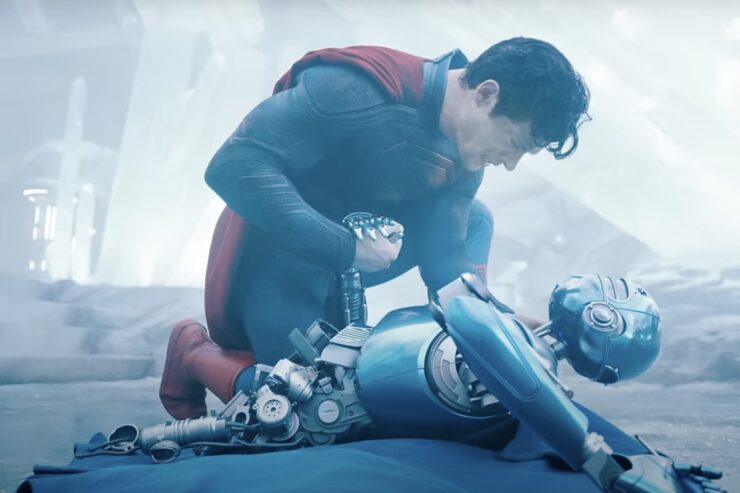
Superman grieves a dead robot. It’s silly because those robots tell him (and us) at the start of the film that they are not people and have no feelings—even though one of them promptly giggles the first time Clark lays eyes on her. (She’s new and excited.) But when Superman returns to the Fortress of Solitude to find it destroyed by Lex and his cohort, he holds one of those robots in his arms and visibly mourns their loss. Now, it’s safe to assume that these robots don’t think of themselves as sentient on account of the people who created them: the Kyptonians. Jor-El doesn’t seem like the kind of guy who cares overmuch about his “tools.” But human beings anthropomorphize everything, and Superman undoubtedly grew up doing the exact same thing alongside us.
You love that Superman grieves a dead robot because you would (and possibly did) also grieve a dead robot.
Superman tells Lex Luthor that he’s no alien by the end of this story; he is tragically, fundamentally human. He learned from us and so he became part of us. He’s human like the people of Metropolis are human, like the people of Jarhanpur, the people of Smallville. In effect, Superman is telling Luthor that he has chosen his found family over his biological one. He choses them the way Martha and Jonathan Kent chose him, the way the crew at the Daily Planet choose the madness of their bullpen peers, the way the Justice Gang choose Metamorpho after he fights one battle beside them. It is something that human beings do every day, and one of our most profound strengths as a species. Anyone can be family if we choose them: adopted children, queer friends, neighbors, coworkers, animals, plants, a town, a city.
You love that Superman chose us as family because you choose your family every single day.
The movie is splattered with these moments, a wild canvas of people carved into two distinct groups: People who care, and people who don’t. And the ones who care come off awkward and vulnerable to anyone who doesn’t. But the ones who care, they are the people that Superman aligns himself with—not because they’re following his lead, but because they set his standard.
So maybe Superman won’t save us—at least, not in the way that some folks are terming it. The things that will save us are already here, and finally getting a little time in our lovely yellow sun. Many fans love superheroes for their ability to give us something aspirational to emulate. But the better ones—maybe the best ones—they remind us that we are the ones worth emulating. Especially all the bits of us that are earnest, honest… and just a little bit embarrassing.

The last paragraph is simply lovely.
The postmodern era of irony makes simple sincerity and earnestness hard to embody, but they ARE values that resonate with people, and when an artist creates with them, they’ll move audiences, unironically.
Lovely post — a much needed reminder of what humanity can and should be. Thanks!
Well said! The last few DC movies tried to make Superman darker and grittier. And in doing so, they missed the point of the character. He is like Marvel’s Captain America, a guy trying his best to live up to high ideals in an imperfect world. This essay gets right to the heart of why I love Superman.
I understand that reference…
(sorry, I couldn’t resist because I love them both.)
The whole point of Superman has always been that he’s a representative of our best qualities magnified.
This right here. I’d been struggling forever to figure out why I love a good Superman. Thank you.